


2025 Summary of Financial Reporting Changes under IFRS and US GAAP and what to expect in 2026
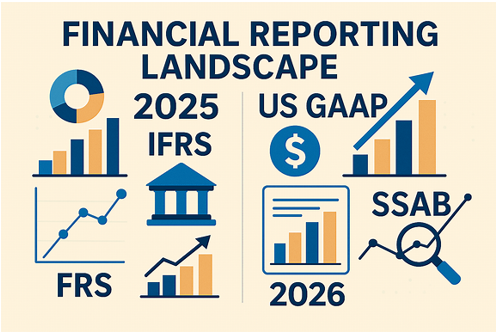
This summary provides a consolidated view of the significant shifts in the financial reporting landscape for 2025 and 2026. As we transition through this period, the focus moves from high-level disclosure to a fundamental restructuring of the financial statements themselves. Read on…
IFRS Landscape: A Structural Re-Engineering
For 2025, there are no "blockbuster" standards becoming effective for the first time, but rather a series of targeted amendments too:
IAS 1 (Classification of Liabilities): Effective for annual periods beginning on or after 1 January 2024 (fully embedded by 2025). Focuses on the right to defer settlement for at least twelve months.
Supplier Finance Arrangements (IAS 7 and IFRS 7): Enhanced disclosure requirements regarding the effects of supplier finance (reverse factoring) on an entity's liabilities and cash flows.
The IASB is implementing changes that will redefine the primary financial statements, requiring entities to rethink their Chart of Accounts (CoA). IFRS 18: Presentation and Disclosure (Effective 2027; Comparatives 2026). IFRS 18 replaces IAS 1 and introduces three mandatory categories in the Statement of Profit or Loss: Operating, Investing and Financing. For the first time, "Operating Profit" is a mandated subtotal, ending the era of inconsistent management definitions. Management Performance Measures (MPMs): Non-GAAP metrics (e.g., adjusted EBITDA) must now be disclosed in a single, audited footnote, requiring a full reconciliation to the nearest IFRS subtotal. While the standard is effective in 2027, the requirement for comparative data means systems must be configured to capture these categories by January 1, 2026.
Lack of Exchangeability (IAS 21): Effective 2025 this new guidance is for determining exchange rates when a currency cannot be converted, critical for groups in volatile jurisdictions.
Looking Ahead to 2026/2027 , there are two big ones to come.
IFRS 19 (Subsidiaries without Public Accountability): A simplified disclosure framework for eligible subsidiaries, significantly reducing the volume of notes required while maintaining recognition and measurement principles.
IASB has finalised narrow‑scope amendments to IAS 21 to address a long‑standing gap on how to translate financial statements when the presentation currency is hyperinflationary but the functional currency is not. The two board scenarios are: A) If the functional currency is not hyperinflationary, but presentational in a hyperinflationary currency- Translate all amounts including comparatives using the closing rate at the reporting date. B) If a parent operates in hyperinflation but has a foreign operation with a non‑hyperinflationary functional currency, then: Comparatives of the foreign operation must be restated using the general price index (IAS 29 principles); and Current‑period amounts are translated using the closing rate.
US GAAP
The FASB’s focus for 2025/26 is on "peeling back the layers" of the Income Statement to provide investors with a natural view of expenses.
ASU 2024-03: Income Statement Disaggregation: Public entities must now break down functional line items (like Cost of Sales or SG&A) into their "natural" components: Employee Compensation, Inventory Expense and Depreciation and Amortisation. This removes the ability to "hide" non-recurring or variable costs within broad functional captions, providing a clearer view of operating leverage.
FASB has been active in addressing specific asset classes and tax transparency too.
Crypto Assets (ASU 2023-08): Effective for fiscal years beginning after December 15, 2024. Entities must now measure "crypto assets" at fair value in each reporting period, with changes recognised in net income, replacing the previous "indefinite-lived intangible" (impairment-only) model.
Income Tax Disclosures (ASU 2023-09): Requires significantly more granular information in the rate reconciliation table and disclosures of income taxes paid, categorised by jurisdiction!
Segment Reporting (ASU 2023-07): Requires public entities to disclose "significant segment expenses" that are regularly provided to the Chief Operating Decision Maker (CODM).
UK GAAP: FRS 102 "Mega-Update"
The Periodic Review 2024 brings UK GAAP into closer alignment with IFRS, representing the most significant shift for private entities in a decade under the New Lease Model (Section 20). Effective 1 January 2026, where the distinction between operating and finance leases for lessees is eliminated.
This means almost all leases (property, fleet, equipment) must be recognized as a Right-of-Use (ROU) Asset and a corresponding Lease Liability. Rental expenses are replaced by Depreciation and Interest, typically resulting in a front-loaded expense profile. EBITDA will appear higher as rent (operating expense) moves to depreciation and interest. Warning: This may trigger breaches in debt covenants linked to leverage ratios.
FRC has commented they will assist Small-Medium Enterprises in navigating the complexity of these regulations as they are trickled down to FRS 102.
SSAB & ISSB: Sustainability Maturation
2025 marks the first mandatory reporting year for many jurisdictions adopting the International Sustainability Standards Board (ISSB) framework - IFRS S1 & S2, which became effective globally from January 2024, 2025, is the "First Reporting Year" for many entities.
Sustainability reporting under IFRS S1 and S2 is moving from voluntary "best practice" to a mandatory endorsement stance, under the UK SDS (Sustainability Disclosure Standards) with large entities moving to mandatory reporting in 2025/26.
The transition relief for Scope 3 (Value Chain) emissions expires in 2025. Furthermore, the market is shifting toward Limited Assurance requirements for climate data. This means UK Multi-nationals/ Global groups must reconcile ISSB/SSAB data with the EU’s CSRD (ESRS) to manage reporting friction, where application guidance points to consider under EFRAG highlights areas an entity starting with ISSB Standards will need to consider in order to also report in compliance with ESRS.
FRC Thematic Priorities (2025/2026 Cycle)
The Financial Reporting Council (FRC) has signalled a "back to basics" approach for its 2024/25 and 2025/26 inspection cycles. Including, pushing for "clear and concise" reporting, removing boilerplate disclosures that obscure material information. Key howlers seen include:
IAS 36: Specifically, the consistency between cash flow forecasts used for impairment testing and the "climate-related risks" discussed in the Strategic Report. Auditors are being pushed to challenge management’s long-term growth rates and discount rates in the face of persistent high-interest environments.
IAS 7: The FRC continues to find high error rates in cash flow classifications (operating vs. investing) with regards to interest and supplier finance.
IFRS 15: A focus on "distinct" goods and services, measuring progress and the timing of revenue for complex long-term contracts and the identification of distinct performance obligations.
IFRS 13: Increasing scrutiny on "Level 3" inputs (unobservable data) for private equity and property valuations.
Critical Outlook for 2026¹
If 2025 is the year of "consolidation," 2026 is the year of convergence and structural change.
FRS 102 (UK GAAP) Major Overhaul: The "Periodic Review 2024" changes become effective for accounting periods beginning on or after 1 January 2026. This includes the transition to an IFRS 16-style on-balance sheet lease model and an IFRS 15-style five-step revenue model.
IFRS 19: Smaller subsidiaries will begin adopting the "Simplified Disclosures" model to reduce the volume of notes in their 2026 filings.
Insurance (IFRS 17): Late adopters and domestic insurers (particularly in India and emerging markets) will conduct "trial runs" in 2026 for 2027 implementation.
Pillar Two (Global Minimum Tax): Continued evolution of disclosures as jurisdictions finalise the implementation of the OECD's 15% minimum tax rate, updates will feature in IAS 12 amendments.
Strategic Recommendation²
IFRS 16 Leases pushed to FRS 102 (known as UK GAAP) will be faced with adoption elections to contemplate about. I have advised clients to use the "modified retrospective" approach for leases to avoid restating every single historical contract but be aware this may affect 2026 comparability. For Lease readiness, Finance Leaders are advised to also perform a Covenant Impact Assessment to establish the combination of higher EBITDA (from lease changes) and a more granular P&L (from IFRS 18/ ASU 2024-03) which may well change the face of financial performance.
If Groups report under both IFRS and US GAAP, ensure your ERP system can handle IFRS 18’s category structure while simultaneously tagging expenses for US GAAP disaggregation under ASU 2024-03. The FRC has stated they will specifically look at the consistency between IFRS 18 MPMs and the narrative reporting in the Strategic Report.
With major updates in IFRS, US GAAP, UK GAAP and the adoption of ISSB standards, finance leaders face both challenges and opportunities to enhance transparency, comparability and decision-making. Proactive planning, system readiness and ongoing education will be essential to navigate these changes successfully and ensure compliance in an increasingly complex regulatory environment¹.
Dee Singh Kothari is a senior partner in Kothari Partners
¹ Ideas expressed in this article are solely of the authors. The author nor Kothari Partner’s accept any liability for the incorrect application of these ideas either used by companies, employees or other individuals alike. Contact us on how we can help with the now.
² At Kothari Partners, our approach is to help our clients understand their current situation, identify the value and decide on the scope, vision and set of strategies for what they could achieve for their business. We help plan their implementation and support them and deliver the solution/ change needed, so it is properly and permanently embedded in their organisation.
We aim to help past and future clients by delivering high-quality work to their organisation, generate real efficiencies and free up time to support better business decisions.
For a confidential discussion please free to contact us, via our corporate website: https://www.KothariPartners.com
Comments