


Beyond Finance & Accountancy… Architecting an AI Target Operating Model for the Generative Era requiring a new way of working
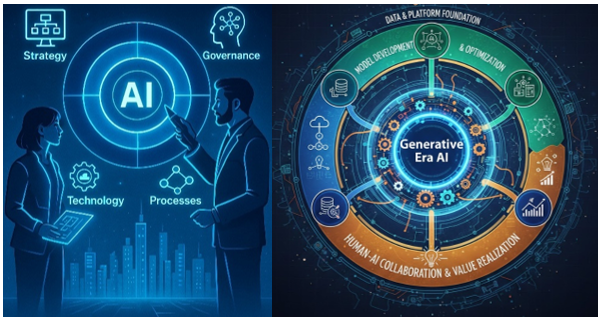
The rapid maturation of Artificial Intelligence (AI) and the disruptive emergence of Generative AI (GenAI) demands more than just technological upgrades; they require a fundamental organisational shift.
Kothari Partners is evolving its own TOM and embracing the ever-changing landscape by adopting AI and ML and embedding it into BAU ways of working when engaging with clients and their projects. The reason for this simple, to demonstrate our core skills and experience, an appetite to grow, stay ahead of the competition and even challenge and use this a differentiation strategy.
During 2024 to date, we have fast tracked our programming proficiency by being Python linguists, embraced Machine Learning Algorithms, by building on our existing financial mathematical repertoire and using decision trees, neural networks, random forests and ensemble methods. Whilst still on the learning curve to master architectures like CNNs, RNNs, Natural Language Processing (NLP) and transformers mainly for text processing, modelling, analysis work and data handling in cleaning, pre-processing and visualising large datasets using numerous API tools¹.
Adopting a cohesive AI Target Operating Model (TOM) is no longer optional, but a prerequisite for scaling value. This model must integrate the unique demands of machine learning workflows—such as data variability and continuous model retraining with the speed, flexibility and customer-centric focus of Lean-Agile principles. I have tried to outline a capability-driven AI TOM built on Lean-Agile philosophy, focusing on aligning People, Process, Technology and Governance to convert AI potential into sustained, measurable business value.
The AI/GenAI Nexus: Why the Old Model Fails
Traditional operating models, designed for transactional systems and deterministic processes, inherently struggle with AI. The core challenge lies in shifting from process logic (if A, then B) to data logic (if A, B and C, then predict D with X% confidence). GenAI accelerates this failure by introducing two critical factors:
Democratisation: GenAI tools (like large language models) move AI capabilities out of the centralised data science team and into the hands of every employee, requiring pervasive governance and literacy.
Unpredictable Velocity: The rapid pace of new models, architectures and capabilities (e.g., agentic workflows) means a static TOM is instantly obsolete. The organisational structure must be built for continuous inspection and adaptation.
A robust AI TOM, therefore, must serve as the adaptive, organisational backbone that manages both classic predictive AI (Machine Learning) and the new, expansive capabilities of GenAI.
Lean-Agile as the Foundational Engine¹
The very nature of AI development iterative, experimental and outcome-focused is perfectly aligned with Lean-Agile methodologies. The core challenge of AI is not technology; it's scaling. Traditional operating models, designed for stability, fail in the face of AI's inherent variability and velocity. Lean Agile principles provide the necessary structure for adaptive governance:
Principle | Lean Agile Focus | Application in AI/Gen-AI TOM |
Value & Flow | Maximise customer value, eliminate waste. | Prioritise AI use cases based on measurable ROI. Use Value Stream Mapping to identify and remove bottlenecks (e.g., data access, legal review). |
Build Quality In | Continuous testing and integration. | Implement Responsible AI (RAI) by Design. Build automated testing for bias, drift, and toxicity directly into the CI/CD pipeline. |
Fast Learning Cycles | Iterate, measure, and adapt quickly. | Implement rapid, small-batch experimentation. Use objective metrics (ROI, accuracy, latency) to base milestones on working, tested systems, not documentation. |
Decentralised Decision-Making | Empower knowledge workers to act locally. | Push Gen-AI capability and governance guardrails to cross-functional "Agentic Teams," allowing them to build and deploy solutions without centralised bottlenecks. |
We utilise Lean-Agile not just for software delivery, but for enterprise transformation.
Embracing Lean Principles (Maximising Value, Minimising Waste)
Lean Principle | Application in AI/GenAI TOM Design |
Define Value | Value is defined by measurable business outcomes (e.g., cost reduction, revenue lift) validated by real-world model performance, not just technical accuracy. |
Map the Value Stream | Identify end-to-end AI/ML value streams, from data ingestion to model deployment and consumption. Eliminate waste such as manual model deployment, data drift monitoring lag, or siloed data access. |
Establish Flow | Implement MLOps (Machine Learning Operations) pipelines to automate the continuous integration, continuous delivery (CI/CD) and continuous training (CT) of models. This is the AI production line. |
Leveraging Agile Principles (Speed, Feedback, Adaptation)
Agile principles provide the necessary organisational flexibility:
Cross-Functional Teams (The Agentic Team): AI initiatives must be executed by multidisciplinary teams (Data Scientists, AI Engineers, Business Domain Experts, Legal/Risk) aligned to a specific business outcome or value stream. This replaces the siloed "Centre of Excellence" (CoE) approach with an Agentic Team structure.
Continuous Feedback Loops: Unlike traditional IT, AI systems require perpetual feedback. Agile’s daily stand-ups and sprint reviews translate into continuous model monitoring in production, allowing teams to quickly address data drift, concept drift, or performance decay.
Iterative Development: The TOM itself is built iteratively. Instead of a single, multi-year blueprint, the TOM is deployed via minimum viable solutions (MVS) that start with simple, governed GenAI use cases (e.g., an internal knowledge copilot) and incrementally adds complexity.
Defining the AI Target Operating Model (TOM) Pillars²
The adaptive AI TOM is structured across four interconnected pillars, ensuring alignment between strategic vision and operational reality:
Pillar 1: People & Organisation (The Agentic Workforce)
The key shift is moving from a hierarchical structure to a Hub-and-Spoke or Agentic Network model.
Hub (AI/GenAI Platform Team): Centralised function responsible for building and maintaining the foundational AI/MLOps platforms, providing data governance, setting ethical guidelines and provisioning enterprise-grade LLMs.
Spokes (Agentic Teams): Decentralised, cross-functional teams embedded within business units, owning the end-to-end lifecycle of a specific AI product.
New Roles & Literacy: Focus on building skills in MLOps Engineering, Prompt Engineering and organisation-wide AI Literacy to ensure responsible and effective GenAI consumption.
Pillar 2: Process & Value Streams (MLOps and CI/CD)
The Lean mindset dictates that all AI work must be viewed as a value stream, governed by standardised MLOps processes:
Use Case Lifecycle Management: Standardised, Agile-driven process for idea submission, prioritisation (ROI vs. Risk), rapid prototyping and industrialisation (scaling a model to production).
Model Monitoring & Continuous Training: Automated workflows that monitor model performance, ethical bias and data quality in real-time, triggering automatic retraining (CT) or human intervention when necessary.
GenAI Guardrails: Standardised processes for fine-tuning private models, managing Retrieval Augmented Generation (RAG) pipelines and ensuring all generated content is screened for hallucination and compliance before release.
Pillar 3: Technology & Data (The Scalable Platform)
The AI TOM relies on a unified, agnostic platform that democratises data and processing power:
Data Mesh / Data Product Focus: Treating data as a product, making high-quality, governed data sets easily discoverable and accessible to Agentic Teams (Spokes).
Modular AI Platform: A cloud-native infrastructure that is model-agnostic (supporting both traditional ML and LLMs/GenAI) and provides standardised tools for experimentation, deployment and security (e.g., authentication, API gateways).
Compute Elasticity: The ability to dynamically scale compute resources for both massive model training (classic AI) and high-volume inference (GenAI endpoints), balancing cost efficiency with performance.
Pillar 4: Governance, Ethics & Risk (Trust-by-Design)
Due to regulatory uncertainty (e.g., EU AI Act) and the risk of GenAI hallucination, Governance cannot be a bottleneck; it must be embedded in the Lean-Agile process.
Responsible AI (RAI) by Design: Ethical considerations, bias checks and transparency requirements are included as non-negotiable definition-of-done items in every Agile sprint for an AI product.
Clear Accountability: Define clear roles and decision rights (DACI matrix) for AI governance, model ownership and incident response when a model fails or generates harmful output.
Auditability & Traceability: Maintain a robust Model and Data Catalog that tracks version control, training data lineage, performance metrics and compliance status for every deployed model, ensuring regulatory auditability.
Iterative Implementation Roadmap²
The AI TOM is not a Big Bang implementation but a structured, iterative transformation:
Phase 1: Readiness & Vision (Lean-Agile Strategy): Conduct an AI Maturity Assessment across all four pillars (People, Process, Tech, Governance). Define the "North Star" vision and prioritise 3-5 high-value, low-risk GenAI and classic AI use cases to serve as Minimum Viable Solutions (MVS).
Phase 2: Establish the Hub (MLOps Foundation): The central Hub team implements the core technological platform, data mesh principles and governance frameworks using an Agile backlog. Focus heavily on MLOps automation to create the foundational value stream flow.
Phase 3: Pilot & Scale the Spokes (Agentic Teams): Launch the prioritised MVS use cases using the Agentic Team structure. These teams operate in short, 2–4-week sprints, delivering tangible, production-ready increments. This phase validates the TOM’s design and drives cultural change through early wins.
Phase 4: Continuous Adaptation (Inspect & Adapt): Institutionalise the use of KPIs (e.g., Time-to-Value for new models, Model Performance Index, AI-driven ROI). The TOM is subject to quarterly review and adaptation based on technology shifts (new LLMs, agent architectures) and validated business feedback.
The convergence of AI and Gen-AI presents an unparalleled opportunity for competitive differentiation. However, without a Lean Agile Target Operating Model, these promising technologies will remain fragmented pilots. By anchoring the TOM in the principles of continuous value delivery, fast iteration, and robust governance, organisations can create a resilient, adaptive structure that enables scalable, responsible and business-driven AI adoption.
Leaders need to begin with an AI Maturity Assessment to define their current state and identify high-value areas for an initial, Lean-driven transformation sprint. This iterative approach ensures your operating model evolves with the technology, rather than chasing it. By embracing the Adaptive AI TOM, organisations stop treating AI as a series of isolated pilot projects and start operating it as an integrated, scalable and continuously optimising engine for competitive advantage.
Dee Singh Kothari is a senior partner in Kothari Partners
¹ The author nor Kothari Partner’s accept any liability for the incorrect application of these ideas either used by companies, employees or other individuals alike.
² At Kothari Partners, our approach is to help our clients understand their current situation, identify the value and decide on the scope, vision and set of strategies for what they could achieve for their business. We help plan their implementation and support them and deliver the solution/ change needed, so it is properly and permanently embedded in their organisation.
We aim to help past and future clients by delivering high-quality work to their organisation, generate real efficiencies and free up time to support better business decisions.
For a confidential discussion please free to contact us, via our corporate website: https://www.KothariPartners.com
Comments